
Overview
Japan is the final frontier for fast food & quick service restaurant market entrants. CarterIGNITE walks you through why making it in Japan means you'll make it anywhere.
In assessments of global food and beverage expansion, Japan is often discussed with a mix of reverence and hesitation. It is viewed by many as a "mature" market; stable, sophisticated, but perhaps lacking the explosive growth potential of emerging APAC neighbors.
However, as we move through 2026, a different reality is emerging. Japan has become the new frontier for fast food, as multiple global brands continue to increase their market share. For strategic leads looking to pitch a market that offers both immediate commercial impact and long-term brand equity, Japan is one of the most dynamic QSR (Quick Service Restaurant) landscapes on the planet. If your brand is investigating APAC and isn't prioritizing Japan, you’re missing the blueprint for the next decade of global fast food growth.
The "Anti-Wellness" Revolution: Reward Culture in 2026
While Western markets continue to grapple with the complexities of "clean eating," Japan’s consumer landscape is witnessing a fascinating reversal. In 2026, we are seeing the rise of a powerful anti-wellness trend among Gen Z consumers, encapsulating a rejection of the high-pressure health-consciousness of the COVID era.
For the QSR sector, this translates into a consumer base that views fast food not as a "cheat meal" but as a vital psychological reward.
This reward culture is further complicated by the arrival of Ozempic and other GLP-1 treatments, which are increasingly discussed on Japanese SNS as new-age beauty treatments. This has created a paradoxical guilt-free indulgence loop: consumers are more experimental and bolder in their food choices, seeking out high-calorie, junk food rewards as a form of stress relief.
Why Japan is #1: The Global Giant Playbook
The belief that Japan is "too hard" is being dismantled by the aggressive expansion of global players. Burger King Japan plans to nearly double their restaurant numbers from 350 to 600 by 2028 after their purchase by Goldman Sachs at the end of 2025. KFC Japan is following a similar strategy after The Carlyle Group took over ownership from Mitsubishi Group, and plans to increase from 1,200 to 1,700 locations by 2030. Meanwhile, McDonald’s Japan, the undisputed market leader, recently reported its strongest financial year on record in 2025, even in the face of ongoing price hikes.
What these brands have realized is that Japan is a "Final Boss" market: if you can win here, you have mastered the highest standards of operations and localization in the world. Further, Japan offers a level of brand loyalty that simply doesn't exist elsewhere.
The Survival Mechanism: Seasonality and Constant Change
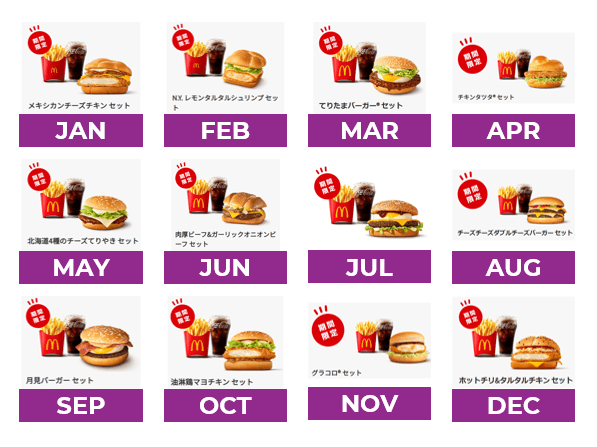
In most markets, a seasonal menu is a marketing tactic. In Japan, it is a survival mechanism. The Japanese consumer is culturally trained to expect constant innovation, variety, and "newness".
McDonald’s Japan behaves less like a global brand with local adjustments and more like a local brand with global assets. They release new, limited-edition products every single month, often tied to the precise changing of the seasons:
Spring: Cherry blossom-themed drinks and Teri-tama (Teriyaki + Egg) burgers.
Autumn: The cult-favorite Tsukimi (Moon-viewing) burgers.
Winter: Comforting Gura-Kuro (Gratin Croquette) burgers.
This "High Seasonality" strategy is critical because seasonal LTOs drive call to action (CTA) for fast food consumers in Japan. If your brand stands still for more than 60 days, you lose your relevance; particularly among Gen Z, who exhibit a fierce enthusiasm for exploring new flavors and limited-edition drops.
The Sophistication of Operations: Real Estate and AI
Entering Japan requires a level of operational sophistication that must be articulated clearly to stakeholders. This isn't just about the menu; it’s about navigating a high-stakes real estate market and a shrinking labor force.
According to Nikkei Asia, Tokyo retail rents increased 4.8% year-on-year by Q3 2025, marking 14 consecutive quarters of growth, with a tight supply-demand situation that makes strategic site selection more critical than ever. To combat labor shortages, the market is leading the world in "Tech-Led Omotenashi." From MOS Burger’s AI-ordering kiosks to the F-Robo cooking robots introduced at Lawson convenience stores to automate fried chicken production, technology is being used to maintain the high standards of customer care (a form of omotenashi) that Japan demands.
Earning Loyalty for Life
The positive story about Japan that every expansion lead needs to tell is the value of the Trust Loop. Japanese consumers are famously risk-averse, and the market has been shaped by past food safety crises. However, once a brand earns that trust through standardization, safety, and consistent innovation, you gain a customer for life.
This loyalty translates into predictable, year-over-year revenue. Whether it is the annual tradition of KFC for Christmas or the monthly rush for a new McDonald’s collaboration (like the August 2025 Pokémon card drop that distributed 3 million packs in just three days), the Japanese consumer integrates QSR brands into their cultural rituals.
Your Strategic Roadmap
At CarterIGNITE, we don't just provide data; we provide the commercial context needed to convince your stakeholders that Japan is the #1 priority for 2026 and beyond. We understand that success in Japan is about more than just food—it's about mood, aesthetics, and omotenashi.
Japan is the next frontier in fast-food. Are you ready to lead the charge?
We've compiled a snippet of some of our latest insights in a free-to-download market report: click here for more details.